Top-rated independent appliance repair across Colorado
Dryer Vent Cleaning & Repair — Book a Visit Today
We clean and repair dryer vents across Colorado, and the fix usually starts with lint packed tight enough to choke the duct. Air slows down, and the dryer bakes clothes instead of drying them. Most failures come from a handful of things: long runs through a crawlspace, crushed foil hose behind the machine, a flap held open by a bird nest, or a vent hood that will not close in the wind. A visit starts with airflow at the hood. Then we open the run, pull the buildup, check joints and tape, and reseal whatever was loose. Damaged sections get replaced, and you hear what we found in plain words. Laundry stacking up? Call us and we will talk through your setup.
Call (888) 352-5066- Real people on the phone
- 7 days a week
- Quote in writing before any work
Taking calls until 5:00 PM MT
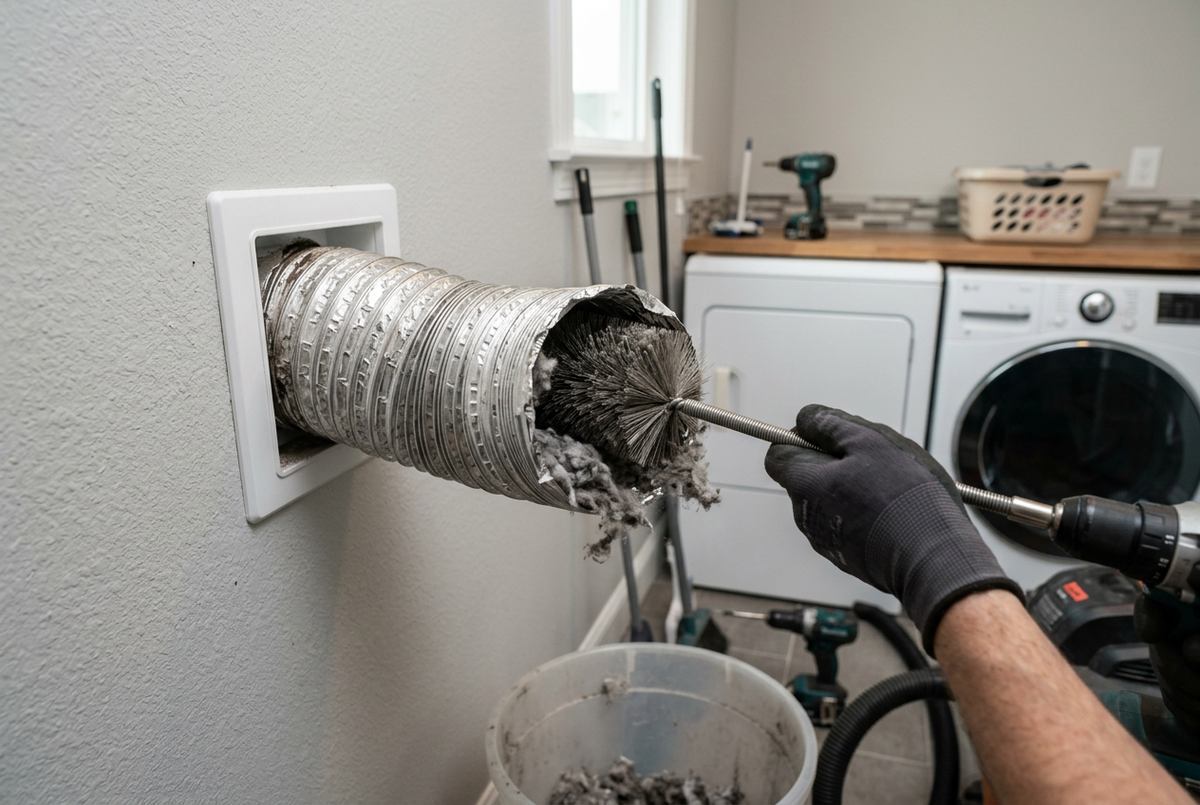
The dryer vent cleaning & symptoms we hear most
- Two cycles and the towels are still damp Restricted duct or crushed transition hose
- The laundry room feels like a sauna Disconnected duct venting moist air indoors
- Hot metal smell when the dryer runs Lint packed against heat, serious fire risk
- Lint keeps showing up on the outside wall Vent hood flap broken or leaking joints
- Dryer shuts itself off partway through Thermal limit tripping from poor exhaust airflow
Safe things to check first
Worth a look before you call — sometimes it saves you the visit.
- 1Pull the dryer out a few inches and look for a kinked or squashed hose behind it.
- 2Step outside while the dryer runs and feel whether air pushes out of the vent hood.
- 3Open the hood flap by hand and check for nesting, snow pack, or matted lint.
- 4Clean the lint screen, then hold it under running water to see if it drains or beads up.
Why homeowners pick a local independent shop
| V-Hood Denver | Big-box repair chains | Handyman listings | |
|---|---|---|---|
| Written quote before any work | ✓ | ✕ | ✕ |
| Phones answered by people, every day | ✓ | ✕ | ✓ |
| Gas and electric, all major brands | ✓ | ✓ | ✕ |
| Independent shop, nobody's quota | ✓ | ✕ | ✓ |
| Local techs who know the housing stock | ✓ | ✕ | ✓ |
After the visit, in their words
“Refrigerator was warm on top, freezing below. Defrost timer swapped, groceries saved.”
Nina C.Burlington, CO“You talk to a human when you call. That alone puts them ahead of everyone else I tried.”
Steve J.Genesee, CO“Two visits, one for diagnosis, one with the ordered part. Both on time, both explained clearly.”
Hannah B.Lincoln Park, CODryer Vent Cleaning & Repair — quick answers
How often should a dryer vent be cleaned?
About once a year for most households. Bump that up if you have a long duct run, pets shedding into laundry, or a big family running loads every day. Short, straight vents can go longer. We check airflow and tell you where yours stands.
Does Denver's altitude change how a dryer vents?
Thinner air carries less mass, so an exhaust system has less margin before drying times stretch out. A duct that would be borderline near sea level often underperforms here. Clean, smooth, short runs matter more at elevation than most homeowners expect.
Can I use the flexible foil hose behind my dryer?
Foil and plastic hose traps lint in its ridges, and it crushes flat when the dryer gets pushed back. Rigid or semi-rigid metal transition duct moves air better and holds its shape. We swap in the right material when we find the old kind.
What if my vent runs up through the roof?
Vertical runs collect lint at the bends and near the cap, and the cap screen can clog solid. We clean these from the accessible end with rotary brushes and check the termination. Roof vents need attention on a regular schedule.
My dryer is in a basement with a long duct. Any options?
Long runs can often be shortened, rerouted, or upgraded to smooth rigid pipe with fewer elbows. Where the path cannot change, a booster fan is sometimes appropriate. We look at the layout first, then recommend.
Do you fix the vent hood outside too?
Yes. Broken flaps, missing louvers, screens that should not be there, hoods sealed shut by paint or caulk, all of that gets addressed. Colorado wind and hail are hard on exterior terminations, so we check the mounting and the seal as well.
How it works
- Step 1
Tell us the symptom
Call or fill out the form and describe the noise, the smell, or the error code. Tell us your altitude and whether the unit vents outside. Those small details decide which parts ride along on the van.
- Step 2
We diagnose on site
A technician looks at the appliance right there in your kitchen or laundry room. We test airflow, heat, drainage, and the electrical side. Then we explain the fault in plain words and lay out your repair options before a wrench comes out.
- Step 3
Repair and airflow check
Once you approve it, we do the work. Before we pack up, we run the appliance and confirm it vents, drains, and cycles the way it should. We clean up the area, then tell you what to keep an eye on next season.
- A real person answers
- Open 7 days
- Written quote before work starts
Why homeowners call us
- Rooted in kitchen ventilationHoods, ducts, and blower motors are where this shop started, and the habit stuck. We look at how air moves through your dryer vent, your fridge coils, your dishwasher drain. Blocked airflow causes more breakdowns than bad parts do.
- Built for thin, dry airColorado altitude changes how burners fire and how moisture leaves a room. Dry air also cracks gaskets and dries seals out early. We account for both when we diagnose, instead of treating your home like it sits at sea level.
- Independent and directWe are an independent repair company and we work on all major brands. No script, no upsell theater. If a repair does not make sense for the age of the machine, we say so out loud and let you decide.
- Clear talk, clean workYou get the fault explained in words you can repeat to your spouse. Drop cloths go down, we respect your floors, and dust from vent work gets vacuumed up before we leave the kitchen.
- All major brands, gas & electricIndependent service on Whirlpool, LG, Samsung, GE, Maytag, Bosch, KitchenAid and the rest.
- Straight answersNot worth fixing? We say that out loud, and often it saves you the visit fee.
Dryer Vent Cleaning & Repair
Small faults become big ones on a schedule of their own
Describe the symptoms and we'll book the visit — takes about a minute.
- A real person answers
- Open 7 days
- Written quotes
- All major brands
- Gas & electric
Rather not call? Get a free quote →