Top-rated independent appliance repair across Colorado
Oven Repair — Book a Visit Today
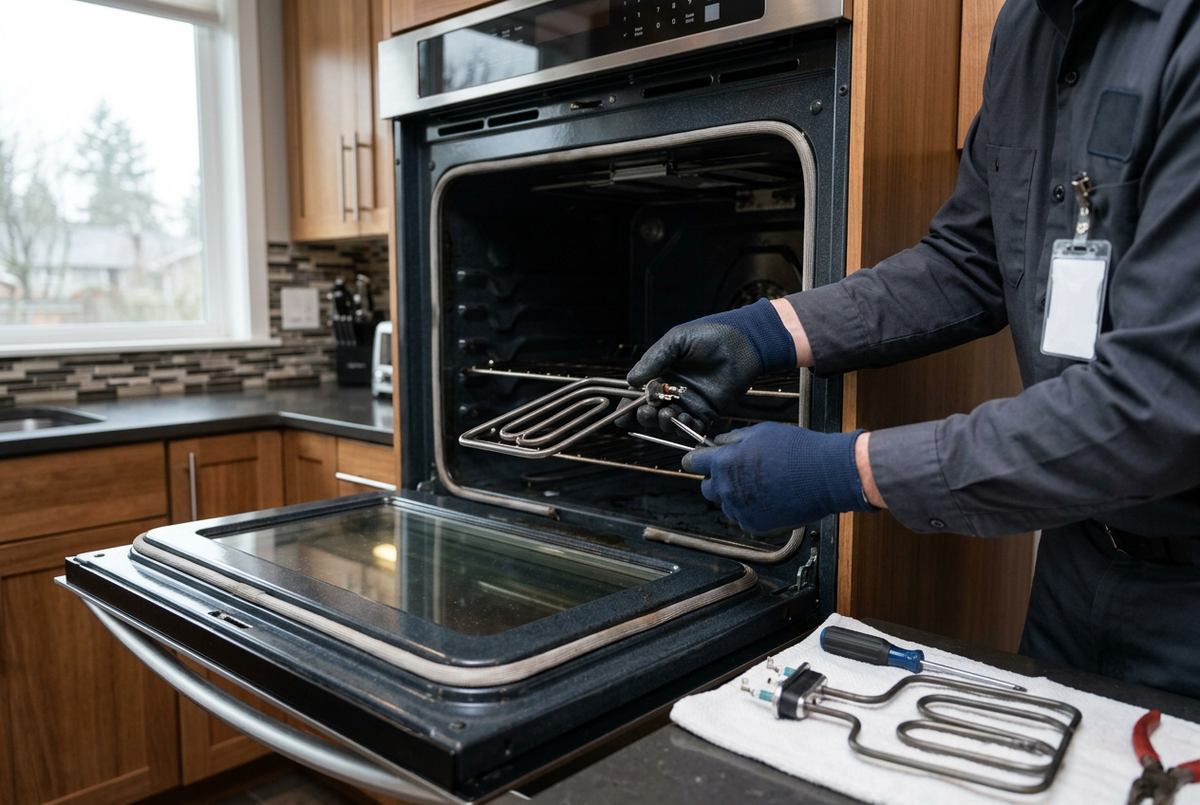
We repair ovens and ranges across Colorado, so call us and tell us what yours is doing. Ovens usually fail slowly. Cookies brown on one side, the preheat beep comes early, and then one Sunday the element glows and quits. Most of it traces back to a short list of parts: bake and broil elements, igniters, thermostats and sensors, door hinges and gaskets, control boards. Mile-high air changes how heat moves through the cavity and how fast gaskets dry out, so Colorado ovens age their own way. A visit starts with your description, then we take a temperature reading and look at the wiring, the sensor, and the door seal. We tell you what we found before anything gets replaced. We work on all major brands as an independent shop.
Call (888) 352-5066- Real people on the phone
- 7 days a week
- Quote in writing before any work
Taking calls until 5:00 PM MT
The oven symptoms we hear most
- "Everything comes out raw in the middle" A weak bake element, a temperature sensor that has drifted, or a control board holding the wrong setpoint.
- "It clicks and clicks but never lights" A worn gas igniter that no longer draws enough current to open the safety valve.
- "The oven runs way hotter than the dial says" Thermostat out of calibration, or a shorted sensor probe feeding the control bad data.
- "Door won't shut all the way anymore" Hinges have sagged, the gasket is crushed, or the inner panel warped and heat is getting out.
- "Display shows a code and the oven locks up" Control board fault, a stuck door latch motor, or an overheat condition tripping the safety logic.
Safe things to check first
Worth a look before you call — sometimes it saves you the visit.
- 1Check that the breaker for the range hasn't tripped. An electric oven can lose bake power while the clock still lights up.
- 2Look along the door gasket for gaps, cracks, or flattened spots where heat could be leaking.
- 3Make sure a self-clean cycle isn't still running or locked, since the latch holds the door shut until the cavity cools.
- 4Put an oven thermometer on the center rack, run the oven to 350, and see what it actually reads after twenty minutes.
Why homeowners pick a local independent shop
| V-Hood Denver | Big-box repair chains | Handyman listings | |
|---|---|---|---|
| Written quote before any work | ✓ | ✕ | ✕ |
| Phones answered by people, every day | ✓ | ✕ | ✓ |
| Gas and electric, all major brands | ✓ | ✓ | ✕ |
| Independent shop, nobody's quota | ✓ | ✕ | ✓ |
| Local techs who know the housing stock | ✓ | ✕ | ✓ |
After the visit, in their words
“Second visit ever, same easy process. Washer spins like it did the day we bought it.”
Danielle M.Burlington, CO“They told me flat out the old freezer was not worth the part cost and helped me plan the swap instead.”
Tom B.Genesee, CO“Called at 8, booked by 8:15, fridge cold before dinner. I did not expect that speed.”
Angela P.Lincoln Park, COOven Repair — quick answers
Why does my oven take so long to preheat in Colorado?
Thinner air at altitude carries less heat, so preheats do feel slower here than at sea level. But a preheat that runs far past normal usually means a weakening element, a lazy igniter, or a sensor reading high.
Is a gas oven that smells faintly of gas an emergency?
Take any gas smell seriously. Shut the supply valve if you can reach it safely, open windows, stay off switches and away from flames, and leave the house if the odor is strong. Call your gas utility first, then us.
Can you fix the oven without replacing the whole range?
Usually yes. Elements, igniters, sensors, thermostats, latches, hinges, and boards are all serviceable parts. We find the actual failure instead of assuming the appliance is done, then talk through what makes sense for your unit.
My oven works but the broiler doesn't. Same problem?
Not always. Bake and broil run on separate elements or burners with their own wiring, so one can quit while the other keeps working. A relay on the control board can also drop out for just one function.
How long does a typical oven repair visit take?
Many jobs wrap up in one visit once we know the fault. Diagnosis eats a good chunk of the time, because we verify how the oven actually behaves at temperature instead of guessing. If a part has to be ordered, we schedule a return and tell you what to expect.
Should I keep using an oven that shows an error code?
Better not to. A code often means the control saw an overheat, a bad sensor signal, or a latch that won't move. Running it anyway puts stress on other parts. Write the code down, unplug the oven or shut the breaker, and call us.
How it works
- Step 1
Tell us the symptom
Call or fill out the form and describe the noise, the smell, or the error code. Tell us your altitude and whether the unit vents outside. Those small details decide which parts ride along on the van.
- Step 2
We diagnose on site
A technician looks at the appliance right there in your kitchen or laundry room. We test airflow, heat, drainage, and the electrical side. Then we explain the fault in plain words and lay out your repair options before a wrench comes out.
- Step 3
Repair and airflow check
Once you approve it, we do the work. Before we pack up, we run the appliance and confirm it vents, drains, and cycles the way it should. We clean up the area, then tell you what to keep an eye on next season.
- A real person answers
- Open 7 days
- Written quote before work starts
Why homeowners call us
- Rooted in kitchen ventilationHoods, ducts, and blower motors are where this shop started, and the habit stuck. We look at how air moves through your dryer vent, your fridge coils, your dishwasher drain. Blocked airflow causes more breakdowns than bad parts do.
- Built for thin, dry airColorado altitude changes how burners fire and how moisture leaves a room. Dry air also cracks gaskets and dries seals out early. We account for both when we diagnose, instead of treating your home like it sits at sea level.
- Independent and directWe are an independent repair company and we work on all major brands. No script, no upsell theater. If a repair does not make sense for the age of the machine, we say so out loud and let you decide.
- Clear talk, clean workYou get the fault explained in words you can repeat to your spouse. Drop cloths go down, we respect your floors, and dust from vent work gets vacuumed up before we leave the kitchen.
- All major brands, gas & electricIndependent service on Whirlpool, LG, Samsung, GE, Maytag, Bosch, KitchenAid and the rest.
- Straight answersNot worth fixing? We say that out loud, and often it saves you the visit fee.
Oven Repair
Small faults become big ones on a schedule of their own
Describe the symptoms and we'll book the visit — takes about a minute.
- A real person answers
- Open 7 days
- Written quotes
- All major brands
- Gas & electric
Rather not call? Get a free quote →