Top-rated independent appliance repair across Colorado
Ice Maker Repair — Book a Visit Today
We repair refrigerator ice makers across Denver, and the fastest way to start is to tell us what the ice looks like when you call us, since shape and smell narrow it down quickly. Ice makers fail in slow motion. Cubes shrink, then hollow out, then stop. Behind that you usually find a clogged water line, a frozen fill tube, a worn inlet valve, a tired thermistor, or a control board that quit talking to the module. Denver's hard water and dry air speed all of it up, with mineral scale building inside valves while cubes shrink from evaporation in a low-humidity kitchen. A visit starts with water pressure and line temperature, then the fill cycle, then the harvest cycle. We watch the machine actually try to make ice before we replace anything. We work on all major brands as an independent shop.
Call (888) 352-5066- Real people on the phone
- 7 days a week
- Quote in writing before any work
Taking calls until 5:00 PM MT
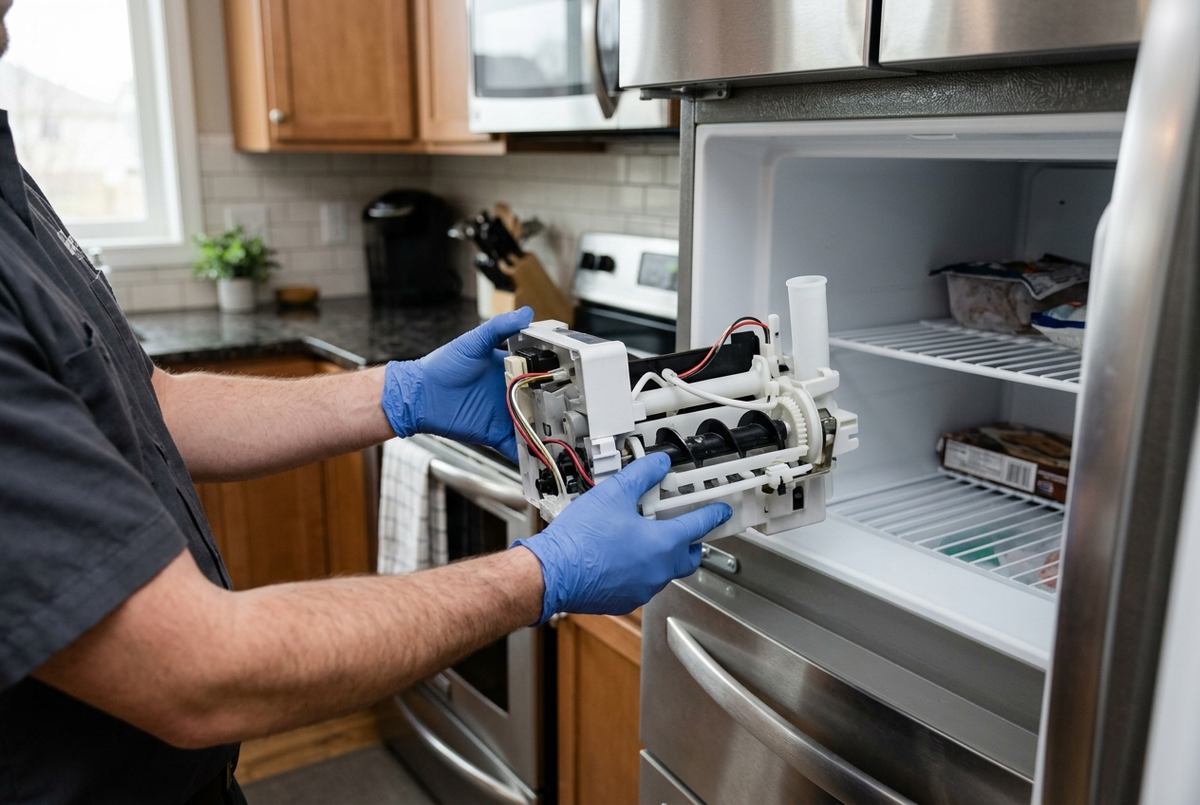
The ice maker symptoms we hear most
- "It stopped making ice completely" Nothing is filling: closed shutoff, frozen line, failed water inlet valve, or a module that never signals harvest.
- "The cubes are tiny and hollow" Low water volume, usually a restricted fill tube, a scaled inlet valve screen, or weak house water pressure to the fridge.
- "Ice tastes stale and smells like the freezer" Old cubes evaporating and absorbing odors. Often a stuck auger, plus a filter and gasket check that is overdue.
- "There's a solid slab in the bin" A slow leak past the inlet valve, or a warm freezer letting cubes melt and refreeze into one block.
- "Water pools under the freezer drawer" Cracked supply line, a misaligned fill tube spraying past the mold, or a drain path blocked by frost.
Safe things to check first
Worth a look before you call — sometimes it saves you the visit.
- 1>
Guides & troubleshooting
Why homeowners pick a local independent shop
| V-Hood Denver | Big-box repair chains | Handyman listings | |
|---|---|---|---|
| Written quote before any work | ✓ | ✕ | ✕ |
| Phones answered by people, every day | ✓ | ✕ | ✓ |
| Gas and electric, all major brands | ✓ | ✓ | ✕ |
| Independent shop, nobody's quota | ✓ | ✕ | ✓ |
| Local techs who know the housing stock | ✓ | ✕ | ✓ |
After the visit, in their words
“Same-week slot, clear arrival window, text when the tech was twenty minutes out.”
Ivy N.Burlington, CO“The quote explained what failed and why, in plain words. I actually understood my own dishwasher for once.”
Wade F.Genesee, CO“Freezer section thawed overnight. They triaged by phone, fit us in early, and saved most of the meat.”
Opal S.Lincoln Park, COIce Maker Repair — quick answers
Why did my ice maker quit after we came back from a trip?
Ice sitting unused evaporates in dry Colorado air, so the bin looks empty even though the machine ran fine. Also check that the door stayed sealed and that nobody bumped the on/off arm or paddle switch.
Is the ice maker or the freezer the real problem?
Both are possible. A freezer running warm cannot freeze a mold on schedule, so ice comes out soft or clumped. We check freezer temperature and door seals before we blame the ice maker itself.
Does Denver water hurt ice makers?
Mineral content leaves scale on valve screens and inside fill tubes. That narrows water flow, which shows up as small or hollow cubes. Regular filter changes slow it down. They do not stop it entirely.
Can you fix a built-in undercounter ice machine?
Yes. Undercounter units add a pump, a condenser, and a drain to the picture. We clean the water path, verify the harvest cycle, and check airflow around the condenser, which clogs with dust fast.
How long does a repair visit take?
Most single-issue visits finish in one appointment. Freeze-ups need thaw time, and some parts have to be ordered. We tell you which situation you are in before we leave the kitchen.
Should I just replace the whole refrigerator?
Not usually for an ice maker alone. Valves, modules, and thermistors are serviceable parts. If the sealed system is also failing on an older unit, we will say so plainly so you can decide.
How it works
- Step 1
Tell us the symptom
Call or fill out the form and describe the noise, the smell, or the error code. Tell us your altitude and whether the unit vents outside. Those small details decide which parts ride along on the van.
- Step 2
We diagnose on site
A technician looks at the appliance right there in your kitchen or laundry room. We test airflow, heat, drainage, and the electrical side. Then we explain the fault in plain words and lay out your repair options before a wrench comes out.
- Step 3
Repair and airflow check
Once you approve it, we do the work. Before we pack up, we run the appliance and confirm it vents, drains, and cycles the way it should. We clean up the area, then tell you what to keep an eye on next season.
- A real person answers
- Open 7 days
- Written quote before work starts
Why homeowners call us
- Rooted in kitchen ventilationHoods, ducts, and blower motors are where this shop started, and the habit stuck. We look at how air moves through your dryer vent, your fridge coils, your dishwasher drain. Blocked airflow causes more breakdowns than bad parts do.
- Built for thin, dry airColorado altitude changes how burners fire and how moisture leaves a room. Dry air also cracks gaskets and dries seals out early. We account for both when we diagnose, instead of treating your home like it sits at sea level.
- Independent and directWe are an independent repair company and we work on all major brands. No script, no upsell theater. If a repair does not make sense for the age of the machine, we say so out loud and let you decide.
- Clear talk, clean workYou get the fault explained in words you can repeat to your spouse. Drop cloths go down, we respect your floors, and dust from vent work gets vacuumed up before we leave the kitchen.
- All major brands, gas & electricIndependent service on Whirlpool, LG, Samsung, GE, Maytag, Bosch, KitchenAid and the rest.
- Straight answersNot worth fixing? We say that out loud, and often it saves you the visit fee.
Ice Maker Repair
Small faults become big ones on a schedule of their own
Describe the symptoms and we'll book the visit — takes about a minute.
- A real person answers
- Open 7 days
- Written quotes
- All major brands
- Gas & electric
Rather not call? Get a free quote →